
"An International Defense Group"
Port Infrastructure Protection Forum
29 April 2026. London
Outcomes and Next Steps
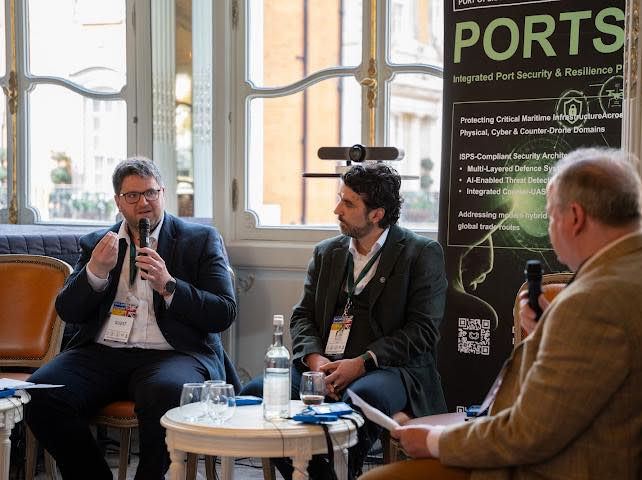
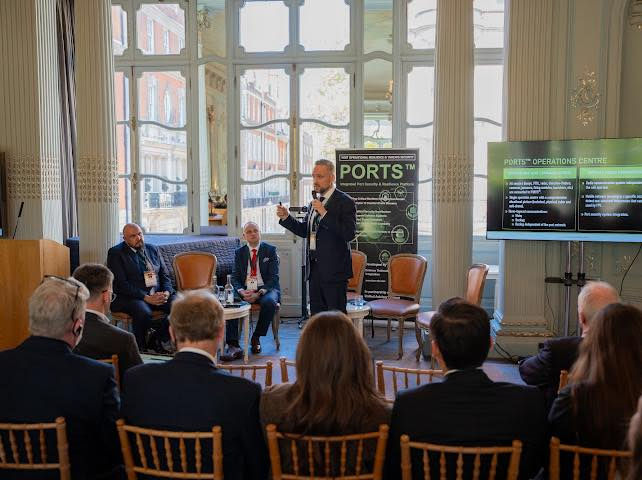
On 29 April in London, the Port Infrastructure Protection Forum was held, focusing on the security of critical maritime infrastructure
The forum brought together representatives from the UK and Ukrainian port sectors, including port operators, industry associations, private terminal operators, ship repair facilities, shipowners, security experts, representatives of the insurance sector, and key UK institutions, including the UK Department for Transport.
The forum was opened by the Ambassador of Ukraine to the United Kingdom of Great Britain and Northern Ireland and Permanent Representative of Ukraine to the IMO, General Valerii Zaluzhnyi.
An online address was also delivered by former Deputy Prime Minister of Ukraine, Oleksandr Kubrakov.


Key Conclusion
The current ISPS Code is no longer fit for purpose in addressing modern threats.
Today, ports are facing:
* large-scale unmanned threats (UAV, FPV, USV)
* integrated cyber and physical attack vectors
* low-cost / high-impact attack scenarios
In practice, the cost of attack versus interception can differ significantly (often reaching ratios of 1:8 or higher), making traditional defence approaches economically unsustainable
Agreed Priorities
Participants supported the following actions:
* the formation of a dedicated working group to establish structured engagement with the International Maritime Organization (IMO)
* the willingness of the Office of the Permanent Representative of Ukraine to the IMO to participate in this initiative
* the initiation of updates to the ISPS Code to reflect modern threat environments
* a shift from compliance-based frameworks towards true operational readiness
Next Step
Participants supported the creation of an international collaborative platform bringing together stakeholders across the maritime infrastructure ecosystem, including:
* ports and stevedoring companies
* shipowners
* infrastructure and service providers supporting port operations
* maritime education and training institutions aligned with IMO standards
* industry experts and technology providers
* the insurance sector
The objective is to establish a unified, system-based approach to port security.
At present, different segments operate under fragmented standards, while a fully integrated security framework does not exist.
This initiative is intended to provide a platform for the development of new standards based on real-world operational experience, modern threat scenarios, and evolving risks.
Practical Approach
During the forum, LAVR UK presented the PORTS™ system, an integrated framework which:
* combines physical security, cybersecurity, and multi-layered threat protection
* delivers coordinated defence across all operational domains
* is built on real-world operational and conflict-driven experience
The system received positive feedback from:
* industry stakeholders
* the insurance sector
* security experts
* representatives of UK governmental and sector-specific institutions
as a practical and scalable model for modern port security.
Education and Workforce Development
A key focus of the discussion was the need to establish a new education and training framework for port security.
PORTS incorporates structured training across all levels — from basic personnel awareness to command-level decision-making.
Partners, including Cherwell College Oxford and International Humanitarian College London IHCL confirmed their readiness to support the rollout of dedicated training programmes.
Why This Matters
Approximately 80% of global trade passes through maritime ports
At the same time, modern threats are:
* low-cost to deploy
* difficult to detect
* capable of disrupting critical infrastructure within hours
We remain open to cooperation with all stakeholders who recognise the urgency of these challenges and are ready to contribute to the implementation of modern, integrated security approaches.
We would like to express our sincere appreciation to all participants, speakers, and partners for their valuable contributions and for the high level and quality of the discussion.
We would also like to extend our sincere appreciation to our partners – United Advisory Group, Cherwell College Oxford, Oxbridge Foundation, and the International Humanitarian College London – for their invaluable support and close collaboration in delivering an event of such high quality and strategic importance.
This marks the beginning of a broader international effort to redefine how maritime infrastructure is protected in the face of evolving global threats.